The Retinoid Pathway Explained: From Retinyl Esters to Tretinoin

Medically Reviewed by Dr. Martyn King
GMC Registered Medical Director
This article has been peer-reviewed and verified for clinical accuracy. Dr. King is an expert in cosmetic medicine, international aesthetic trainer, and Founder of the Aesthetics Complications Expert Group (ACE).
If you have ever tried to choose a vitamin A skincare product, the terminology can feel unnecessarily complicated. Retinol, retinal, retinaldehyde, retinyl palmitate, retinoids and tretinoin are often discussed as though they are interchangeable—or as simple steps on a percentage scale. Dr Martyn King says they are not.
The first point to understand is that retinoid is the umbrella term for vitamin A and its natural and synthetic derivatives. Retinol, retinaldehyde and tretinoin are all retinoids. “Retinoid” is therefore not a separate ingredient or strength.
For the naturally occurring vitamin A pathway used in skincare, the simplest potency order is:
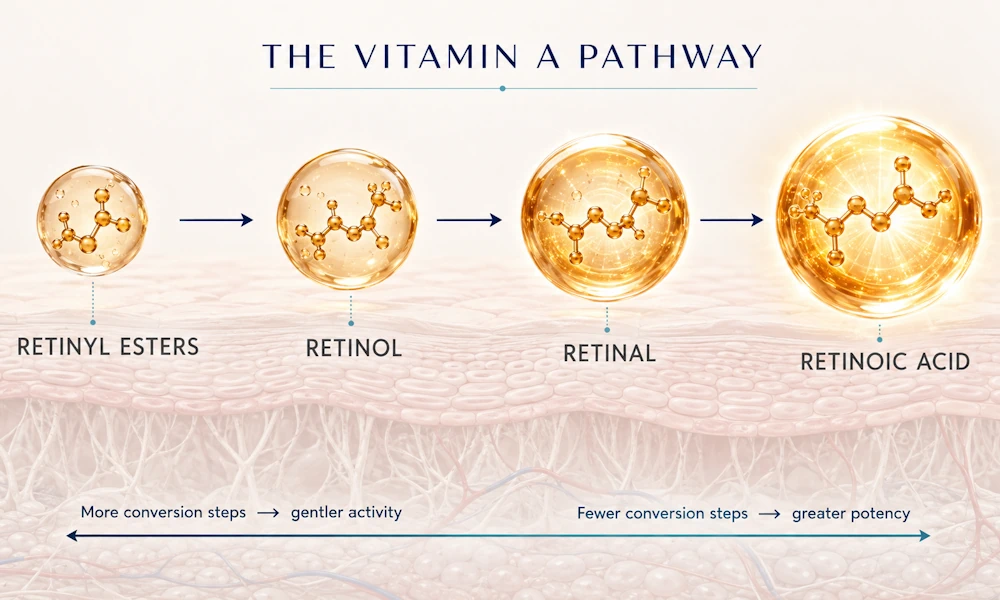
Retinyl esters → Retinol → Retinal (retinaldehyde) → Retinoic acid (tretinoin)
As we move from left to right, fewer conversion steps are needed before the molecule becomes retinoic acid—the form that can directly activate retinoic acid receptors in skin cells. In general, this means greater biological activity, stronger evidence and a higher risk of irritation.
However, this is a pathway rather than a precise dose-equivalence chart. A well-formulated, stable retinol product may outperform a poorly formulated retinal product. Concentration, delivery system, packaging, stability and frequency of use all matter.
Why must cosmetic retinoids be converted?
Retinoic acid is the biologically active end point of the pathway. Inside a skin cell, it binds to nuclear retinoic acid receptors (RARs). These receptors pair with retinoid X receptors (RXRs) and interact with specific regions of DNA known as retinoic acid response elements. The resulting changes in gene transcription influence epidermal cell growth and differentiation, pigmentation, inflammation and components of the extracellular matrix. This is why topical retinoids can improve fine lines, uneven pigmentation, rough texture and acne. Their effects include normalising keratinocyte behaviour, increasing epidermal turnover, supporting collagen production and reducing signalling that promotes collagen breakdown.
Cosmetic vitamin A derivatives are one or more metabolic steps removed from retinoic acid:
- Retinyl esters are hydrolysed to retinol. Enzymes cleave the fatty-acid ester bond.
- Retinol is oxidised to retinaldehyde. This is catalysed mainly by retinol dehydrogenase enzymes and is a reversible, regulated step.
- Retinaldehyde is oxidised to retinoic acid. Retinaldehyde dehydrogenases catalyse this largely irreversible step.
- Retinoic acid binds to RARs. It does not require further activation.
The skin also protects itself against excessive retinoid signalling. Retinol can be stored again as retinyl esters, while retinoic acid is broken down by CYP26 enzymes into less active metabolites. Conversion is therefore controlled rather than automatic or complete.
The retinoid strength ladder: Weakest to Strongest
1. Retinyl Esters: The gentlest starting point
Common names on an ingredient list include retinyl palmitate, retinyl acetate and retinyl propionate.
Retinyl esters are formed when retinol is joined to a fatty acid. Esterification makes vitamin A more suitable for storage and can improve formulation stability. The skin must first cleave the ester bond to release retinol; the retinol must then be converted to retinaldehyde and finally to retinoic acid.
Because three steps stand between a retinyl ester and active retinoic acid—and because only a proportion is converted at each stage—retinyl esters usually produce the mildest retinoid effect. They tend to be better tolerated, but evidence for meaningful improvement in established photoageing is more limited than for retinol, retinaldehyde or tretinoin.
Best suited to: beginners, cautious users and people who have not tolerated stronger vitamin A products.
Limitations: gentleness may also mean slower or subtler results. Retinyl palmitate should not be described as equivalent to retinol at the same percentage.
2. Retinol: the best-known cosmetic retinoid
Retinol is the alcohol form of vitamin A. It requires two oxidation steps: first to retinaldehyde and then to retinoic acid.
It is lipid-soluble, which helps it enter the outer skin barrier, but successful penetration is not the same as complete conversion or guaranteed effectiveness. Retinol is also chemically fragile: light, heat and oxygen can degrade it. Opaque, air-restrictive packaging and a properly stabilised formulation are therefore important.
Human skin research has shown that topical retinol can penetrate skin and create molecular and cellular changes similar in type—though not equal in potency—to retinoic acid. One experimental human study found that 0.25% retinol induced changes similar to 0.025% retinoic acid in its particular test vehicle. This is useful scientific context, but it should not be turned into a universal “ten times weaker” conversion rule for commercial products.
Best suited to: consumers wanting a well-researched cosmetic option for fine lines, texture and uneven tone, with more tolerability than prescription tretinoin.
Limitations: can still cause dryness, redness, peeling and stinging; results depend heavily on stability and formulation.
3. Retinal and retinaldehyde: two names, one ingredient
Retinal and retinaldehyde are the same molecule. “Retinal” is simply the shorter name.
Retinaldehyde is the aldehyde form of vitamin A and sits only one oxidation step away from retinoic acid. This is the main reason it is generally considered more potent than retinol at comparable, appropriately formulated concentrations. Its metabolism is particularly interesting because retinaldehyde lies at a junction. It can be oxidised irreversibly to retinoic acid, or reduced back to retinol and then stored as retinyl esters. The skin can therefore regulate how much proceeds towards active retinoic acid.
Retinaldehyde has evidence for improving photoaged skin and is often reasonably well tolerated, although it can still irritate. It is challenging to formulate because it is reactive and vulnerable to degradation; encapsulation and protective packaging may improve stability and delivery.
Best suited to: experienced retinol users wanting a stronger cosmetic step without moving to a prescription medicine.
Limitations: usually more expensive, potentially more irritating and not automatically superior if the formula is unstable.
4. Retinoic acid and tretinoin: active without conversion
Tretinoin is all-trans retinoic acid. It is already in the receptor-active form, so skin enzymes do not need to convert it before it can signal through RARs.
Tretinoin has the strongest and longest-established evidence in this pathway for treating acne and improving features of photodamage. It can influence epidermal organisation, pigmentation and dermal matrix remodelling, including collagen-related pathways.
That direct activity also explains its greater tendency to cause retinoid dermatitis: redness, dryness, peeling, burning or stinging. Tretinoin is a prescription-only medicine in the UK and should be used for an appropriate clinical indication under the direction of a qualified prescriber. It is not simply a stronger cosmetic serum.
Best suited to: patients for whom a prescriber considers tretinoin clinically appropriate.
Limitations: irritation is common, careful introduction is required and it is not appropriate during pregnancy.
Where do adapalene, tazarotene and other “retinoids” fit?
Not every retinoid follows the retinyl ester-to-tretinoin pathway.
Adapalene, tazarotene and trifarotene are synthetic topical retinoid medicines designed to interact with selected retinoic acid receptors. Tazarotene is itself a prodrug converted in the skin to tazarotenic acid. These medicines differ in receptor selectivity, approved uses, tolerability and evidence; they cannot be accurately arranged as extra steps between retinal and tretinoin.
Newer cosmetic ingredients such as hydroxypinacolone retinoate (HPR), retinyl retinoate and various encapsulated derivatives are also marketed as “next-generation retinoids”. Their manufacturers may propose direct receptor activity or alternative conversion routes, but independent comparative human evidence is much less extensive than for established retinol, retinaldehyde and tretinoin. Marketing descriptions such as “granactive retinoid” should not be mistaken for a universally agreed potency category.
Absorption: stronger on the label does not always mean stronger in the skin
For a topical retinoid to work, it must be released from its formula, remain chemically intact, cross the stratum corneum and reach viable skin cells. Several factors change that journey:
- Molecular form: retinoids are lipid-soluble, but their exact polarity and structure affect partitioning through skin.
- Vehicle: creams, gels, oils and emulsions release and deliver ingredients differently.
- Encapsulation: liposomes, polymer capsules and other carriers may protect a fragile retinoid and alter its release.
- Stability: oxygen, ultraviolet light and heat can isomerise or degrade vitamin A derivatives.
- Skin condition: damaged or inflamed skin may absorb more and become more irritated.
- Application: dose, frequency, use over moisturiser and other active ingredients all affect tolerability and exposure.
Absorption is not the same as systemic exposure. Most of a correctly used topical product acts locally, and systemic exposure to topical medicinal retinoids is generally low. Nevertheless, pregnancy precautions still apply.
Can percentages be compared?
Only with considerable caution. A 0.1% retinal product is not directly comparable with a 0.1% retinol product, and neither can be equated to 0.1% tretinoin. Even two products containing the same retinoid percentage may behave differently because of their formulation and stability.
Claims that retinal is always “11 times stronger” than retinol, or that retinol is exactly “20 times weaker” than tretinoin, oversimplify experimental findings. There is no universally accepted conversion calculator covering finished skincare products.
A more honest way to compare products is to ask:
- Which exact retinoid is present?
- What is its disclosed concentration?
- Is the formula stabilised and suitably packaged?
- Is there evidence on the finished product, not only the raw ingredient?
- Can the user apply it consistently without unacceptable irritation?
How to introduce a retinoid safely
Start with a low frequency—often two evenings a week—and increase gradually if the skin remains comfortable. Apply a small amount to dry skin, avoiding the eyelids, corners of the nose and lips unless the product is specifically intended for those areas. Follow with moisturiser; very sensitive users may apply moisturiser before and after the retinoid.
Do not introduce several irritating active ingredients at once. Strong exfoliating acids, benzoyl peroxide and other potentially irritating products may need to be separated or introduced cautiously. Daily broad-spectrum sunscreen is essential because ultraviolet exposure drives photoageing and irritated skin may be less tolerant of sunlight.
Temporary mild dryness can occur, but persistent burning, swelling, cracking or severe inflammation is a reason to stop and seek professional advice.
As a precaution, avoid topical retinoids during pregnancy or when planning pregnancy. UK medicines guidance contraindicates topical medicinal retinoids during pregnancy even though systemic exposure is thought to be negligible, because risk cannot be excluded. Anyone breastfeeding, undergoing dermatological treatment or managing eczema, rosacea or a damaged skin barrier should seek individual professional advice.
The take-home message
The closer a natural vitamin A derivative sits to retinoic acid, the fewer conversions it needs and the greater its potential activity:
Retinyl esters are generally the gentlest; retinol is the established cosmetic workhorse; retinaldehyde is one step closer to activity; and tretinoin is active retinoic acid and a prescription medicine.
The strongest product is not automatically the best product. A retinoid that is stable, well-formulated and tolerated well enough to use consistently is usually a better choice than a theoretically stronger product that repeatedly disrupts the skin barrier.
Evidence and further reading
- Duell EA, Kang S, Voorhees JJ. Unoccluded retinol penetrates human skin in vivo more effectively than unoccluded retinyl palmitate or retinoic acid. J Invest Dermatol. 1997;109(3):301–305. https://pubmed.ncbi.nlm.nih.gov/9284094/
- Zasada M, Budzisz E. Retinoids: active molecules influencing skin structure formation in cosmetic and dermatological treatments. Postepy Dermatol Alergol. 2019;36(4):392–397. https://pmc.ncbi.nlm.nih.gov/articles/PMC6791161/
- Mukherjee S, et al. Retinoids in the treatment of skin aging: an overview of clinical efficacy and safety. Clin Interv Aging. 2006;1(4):327–348. https://pmc.ncbi.nlm.nih.gov/articles/PMC2699641/
- Milosheska D, Roškar R. Use of retinoids in topical antiaging treatments: a focused review of clinical evidence for conventional and nanoformulations. Adv Ther. 2022;39:5351–5375. https://pmc.ncbi.nlm.nih.gov/articles/PMC9618501/
- MHRA. Oral retinoid medicines: revised and simplified pregnancy prevention educational materials for healthcare professionals and women. https://www.gov.uk/drug-safety-update/oral-retinoid-medicines-revised-and-simplified-pregnancy-prevention-educational-materials-for-healthcare-professionals-and-women
Consumer information notice: This article is for general education and does not replace medical advice. Prescription retinoids should only be used under the direction of an appropriately qualified prescriber.