Vitamin C in Skincare: Why Formulation Matters More Than the Percentage

Medically Reviewed by Dr. Martyn King
GMC Registered Medical Director
This article has been peer-reviewed and verified for clinical accuracy. Dr. King is an expert in cosmetic medicine, international aesthetic trainer, and Founder of the Aesthetics Complications Expert Group (ACE).
Contents
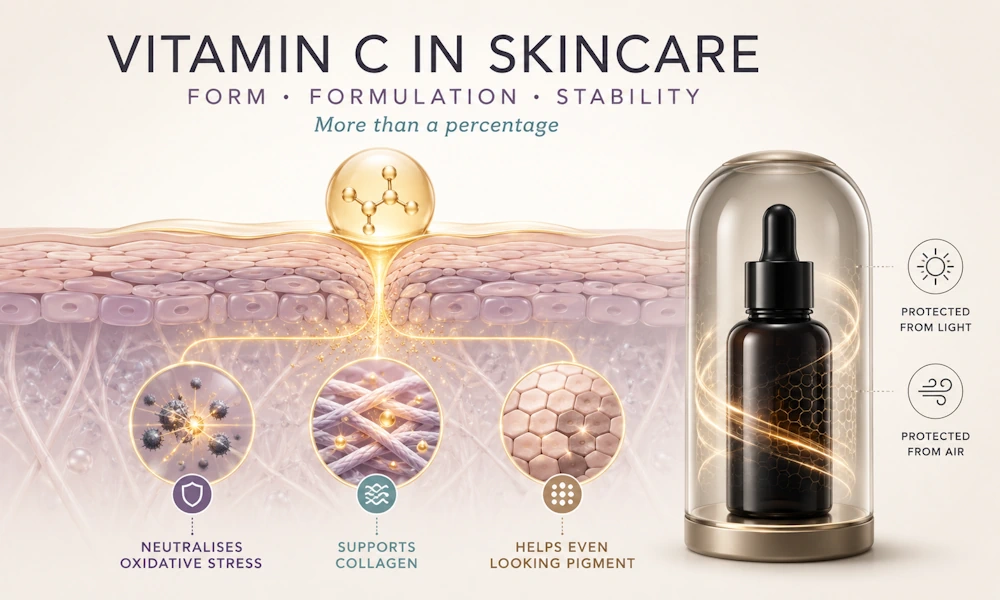
Vitamin C is one of skincare’s best-known active ingredients. Serums are advertised at 5%, 10%, 15%, 20% and sometimes even higher, creating the impression that the largest number must produce the best result. The science is more interesting—and more useful—than that.
A vitamin C product can only work if its active ingredient remains stable in the bottle, is released from the formula, crosses the skin barrier and reaches living skin cells in a form they can use. The type of vitamin C, pH, formulation, packaging and supporting antioxidants can therefore matter as much as—and sometimes more than—the headline percentage.
This explains why a fresh, carefully formulated 10–15% serum may be a better purchase than a poorly protected 20–30% product that oxidises quickly or cannot deliver its vitamin C effectively.
What does vitamin C do in the skin?
Vitamin C is the collective name commonly used for ascorbic acid and related compounds. In biological systems, the active form is L-ascorbic acid, also called ascorbic acid. It is an essential water-soluble antioxidant and an enzyme cofactor. Humans cannot manufacture vitamin C because we lack the final enzyme in its biosynthetic pathway. It must therefore come from the diet. Blood vessels deliver dietary vitamin C to the skin, but topical application is intended to increase local availability in the epidermis and dermis. Eating well and applying a serum are not interchangeable routes.
Topical vitamin C is used for three main reasons.
1. Antioxidant support
Ultraviolet radiation, visible light, pollution and normal cellular metabolism can generate reactive oxygen species. These highly reactive molecules can oxidise lipids, proteins and DNA and activate pathways involved in inflammation and collagen breakdown. L-ascorbic acid can donate electrons to neutralise reactive species. In doing so, ascorbate becomes an ascorbyl radical and may then be oxidised to dehydroascorbic acid. Cellular antioxidant systems can recycle some oxidised vitamin C back to ascorbate. This antioxidant action helps explain why topical vitamin C can supplement photoprotection. It does not absorb or block ultraviolet radiation in the way an approved sunscreen filter does and must never be presented as an alternative to sunscreen.
2. Collagen support
Vitamin C is a cofactor for prolyl and lysyl hydroxylase enzymes, which hydroxylate selected amino acids during collagen production. These reactions help newly formed collagen chains adopt a stable triple-helix structure and support subsequent cross-linking. Vitamin C may also influence collagen gene expression and help limit oxidative signalling associated with matrix metalloproteinases—the enzymes that break down parts of the extracellular matrix. Human studies have found biochemical and clinical improvements with some topical vitamin C formulations, although the evidence is much smaller and more formulation-specific than advertising often suggests.
3. Uneven pigmentation
Melanin production depends on the copper-containing enzyme tyrosinase. Vitamin C can interfere with oxidative steps involved in melanin formation and reduce oxidised pigment intermediates. This can support a brighter, more even-looking complexion.
Vitamin C is not a bleaching agent and results are gradual. Persistent or complex pigmentation, including melasma and post-inflammatory hyperpigmentation, usually responds best to a broader plan incorporating rigorous sun protection and appropriately selected treatments.
First you need to understand the different forms of vitamin C
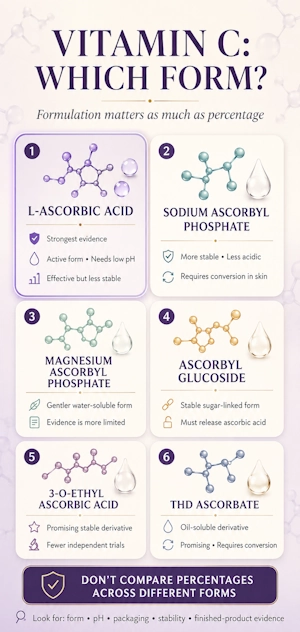
“Contains vitamin C” is not enough information to judge a product. The ingredient may be pure L-ascorbic acid or one of many derivatives designed to improve stability or tolerability.
L-ascorbic acid: The benchmark form
L-ascorbic acid has the most direct biological relevance and the strongest history of topical research. It does not need to be enzymatically converted from a derivative before functioning as ascorbate. Its disadvantages are equally important. It is hydrophilic, while the stratum corneum is a lipid-rich barrier, and at neutral pH much of the molecule is ionised. It is also readily oxidised by air, light, heat, water and trace metals.
An influential pig-skin penetration study found that L-ascorbic acid needed to be formulated below pH 3.5 to enter the skin effectively and that skin levels reached a maximum at 20%. Increasing the concentration above 20% did not improve delivery in that experimental model. This is the origin of much of the familiar 10–20% formulation guidance. It is valuable evidence, but it is not a universal rule proving that every 20% commercial serum is optimal. It was a specific experimental model, and finished products differ greatly.
Vitamin C derivatives: More stable, but not automatically more effective
Manufacturers chemically modify ascorbic acid to create derivatives that may tolerate water, oxygen, light or a higher pH more successfully. Some are water-soluble salts or sugar conjugates; others are lipid-soluble esters or ethers.
For most derivatives, chemical stability is an advantage but biological activity depends on one or more additional questions:
- Can the derivative cross the stratum corneum?
- Is it converted to active ascorbic acid in human skin?
- How much is converted and where?
- Has the finished product demonstrated a clinical benefit?
A derivative may be an excellent choice for sensitive skin or for a formula in which L-ascorbic acid would be impractical. It should not, however, be assumed equivalent to the same percentage of L-ascorbic acid. Ten per cent THD ascorbate, for example, is not directly dose-equivalent to 10% L-ascorbic acid.
Why the highest percentage is not necessarily the best
The percentage on a label describes how much ingredient was placed in the formula; it does not tell us how much remains active when the customer uses it or how much reaches the relevant skin layer.
1. Absorption does not increase indefinitely
In the classic percutaneous absorption study, L-ascorbic acid delivery increased up to 20%, then reached a plateau. A concentration above this may add irritation or crystallisation risk without improving skin delivery.
2. The form changes the meaning of the number
Percentages cannot be compared directly across L-ascorbic acid, SAP, MAP, THD ascorbate or ascorbyl glucoside. They have different molecular weights, solubility, skin partitioning and conversion requirements.
3. pH affects both penetration and tolerance
An acidic pH keeps more L-ascorbic acid in its non-ionised form, improving its ability to cross the lipid-rich stratum corneum. The same acidity can cause stinging or irritation, particularly in rosacea-prone or barrier-impaired skin. Many derivatives can be formulated closer to the skin’s natural pH. They may therefore be more comfortable, even if the evidence for biological activity is less extensive.
4. An oxidised product may have lost useful activity
L-ascorbic acid begins as a colourless compound. Oxidation produces dehydroascorbic acid and then further degradation products, often accompanied by progressive yellow, orange or brown discolouration. Once substantially degraded, the percentage printed on the box no longer represents the amount of active L-ascorbic acid reaching the skin. Some formulas are naturally pale yellow because of ingredients such as ferulic acid, so colour must always be judged against the product’s appearance when new and the manufacturer’s guidance.
5. The vehicle controls delivery
Water content, solvents, emulsifiers, penetration enhancers, encapsulation and film formation all affect how vitamin C is released and delivered. Packaging also determines how much oxygen and light reaches the formula during daily use.
6. Consistency beats theoretical maximum strength
A product that causes repeated burning or dermatitis will be used inconsistently or abandoned. The most effective choice is often the strongest evidence-based formulation that the individual can use comfortably and regularly.
What evidence supports topical vitamin C?
The biological rationale is strong, but the clinical evidence needs to be interpreted honestly. Small controlled human studies have reported improvements in features of photoageing, including fine wrinkling, tactile roughness and some pigmentation measures. A double-blind study of a 5% vitamin C cream found clinical and tissue changes in photoaged skin after six months. Another split-face trial found improvement on the vitamin C-treated side.
These studies demonstrate that a product does not need to display the largest percentage to produce a measurable result. They also do not prove that all products containing the same percentage will behave identically.
Many published studies are small, short, use different formulations or are supported by manufacturers. There are relatively few direct, independent comparisons between modern commercial vitamin C forms. Claims should therefore be tied to the tested formula rather than transferred uncritically to every serum sharing one ingredient.
What can potentiate or complement Vitamin C?
Vitamin E
Vitamin C works in the water-based compartments of skin, while vitamin E—particularly alpha-tocopherol—is a lipid-soluble antioxidant that helps protect cell membranes and skin lipids. Vitamin C can help regenerate vitamin E after it has neutralised a free radical, creating a complementary antioxidant network. Experimental studies have found greater photoprotective effects from combined topical vitamins C and E than from either alone in some models.
Ferulic acid
Ferulic acid is a plant-derived antioxidant. A widely cited study found that adding 0.5% ferulic acid to a particular solution containing 15% L-ascorbic acid and 1% alpha-tocopherol improved chemical stability and approximately doubled the formulation’s measured photoprotection in that study. This supports a specific evidence-based combination. It does not mean that any product listing vitamin C, vitamin E and ferulic acid will necessarily reproduce the same result: concentrations, pH, solvents, packaging and manufacturing all matter.
Broad-spectrum sunscreen
This is the most important practical partnership. Sunscreen reduces the amount of ultraviolet radiation reaching the skin; antioxidants help neutralise some reactive species generated despite that protection. Research suggests the approaches can be complementary. Apply vitamin C first, allow it to settle, then use a generous amount of broad-spectrum sunscreen. Vitamin C never replaces SPF.
Other skincare ingredients
Vitamin C can be used in the same overall routine as niacinamide. The old claim that the two ingredients inevitably deactivate one another arose from laboratory conditions that do not reflect modern cosmetic formulations and normal use. The more relevant issue is irritation and product compatibility, not an unavoidable chemical prohibition.
Retinoids and exfoliating acids can also coexist in a skincare plan, but combining several irritating actives in one application may be poorly tolerated. For many users, vitamin C in the morning and a retinoid in the evening is a simple, comfortable arrangement rather than a chemical necessity.
When should vitamin C be applied?
Morning is usually the most logical time
Vitamin C’s antioxidant role complements daytime sunscreen, so morning application is usually preferred:
- Cleanse and gently dry the skin.
- Apply the vitamin C product according to its directions.
- Follow with moisturiser if required.
- Finish with broad-spectrum sunscreen.
Do not mix a carefully formulated serum into moisturiser or sunscreen in your hand. This dilutes the product unpredictably, may alter its pH and can compromise even sunscreen application.
Evening use is also acceptable
Vitamin C does not stop working because it is dark. Evening use can be suitable if the formula layers poorly in the morning or if separating it from other products improves comfort. Consistency and tolerability matter more than a rigid rule. Some experimental work suggests skin vitamin C can remain after application and build a local reservoir, but this should not be used to justify ignoring the product’s recommended frequency.
How to introduce vitamin C
For normal, resilient skin, a well-formulated L-ascorbic acid product in the 10–15% range is often a sensible starting point. Experienced users may choose up to 20% if appropriate and well tolerated. Higher is not automatically better.
Sensitive, dry, rosacea-prone or barrier-impaired skin may prefer:
- a lower concentration of L-ascorbic acid;
- less frequent application initially; or
- a more stable, less acidic derivative in a well-designed formula.
Begin every other morning or several times a week, then increase as tolerated. Mild brief tingling can occur with an acidic formula, but persistent burning, itching, swelling, marked redness or dermatitis is not a sign that the product is “working”. Stop and reassess.
Patch testing can reduce—but cannot completely eliminate—the risk of irritation or allergy. Anyone with active eczema, significant rosacea, a damaged skin barrier or ongoing dermatological treatment should seek individual professional advice.
How should vitamin C be stored?
Storage is particularly important for L-ascorbic acid products.
- Keep it away from light. Opaque, UV-protective packaging is preferable to a clear bottle.
- Limit exposure to air. Replace the cap promptly and keep the neck or dropper clean. Airless packaging can be advantageous.
- Keep it cool and stable. Avoid sunny windowsills, bathrooms that become hot and steamy, radiators and hot cars.
- Follow the manufacturer’s instructions. Refrigeration may help some products but is not universally required and may affect others. Do not refrigerate unless the brand advises or permits it.
- Do not decant it. Moving the serum into a decorative clear bottle increases exposure and may compromise the protective packaging.
- Note the opening date. This helps identify an ageing product even when its appearance changes slowly.
Compare the serum with its original colour. Progressive darkening to deep yellow, orange or brown, a significant odour change, separation or altered texture may indicate deterioration. Because some formulations are naturally coloured, use the brand’s instructions rather than a universal colour chart.
How to assess a vitamin C product properly
Instead of choosing the largest number on the front of the box, ask:
- Which exact form is used? “Vitamin C complex” is less informative than a full ingredient name.
- Is the concentration disclosed? Disclosure is helpful, but it must be interpreted in the context of the form.
- For L-ascorbic acid, is the pH and delivery system credible? Effective acidic formulas must also be tolerable.
- Is the packaging protective? Look for opaque or tinted, well-sealed packaging with limited air exposure.
- Are supporting antioxidants included at meaningful levels? Vitamin E and ferulic acid have a plausible and evidence-supported rationale, but the finished formula still matters.
- Is there testing on the finished product? Ingredient theory is weaker evidence than stability, penetration or clinical testing of the actual formula.
- Will it remain fresh during normal use? Bottle size, dispensing system and period after opening matter.
- Can you tolerate and use it consistently? Irritation can erase the practical advantage of a theoretically stronger concentration.
The take-home message
Vitamin C has credible scientific roles as an antioxidant, a collagen-synthesis cofactor and a modulator of pigment formation. L-ascorbic acid has the strongest established topical evidence, but it is difficult to formulate and keep stable. Derivatives may improve stability and comfort, although their conversion and clinical evidence vary.
The percentage alone cannot tell you whether a product will work:
Form + concentration + pH + stability + packaging + delivery + consistent use determine the real value of a vitamin C product.
A fresh, protected and well-tolerated serum used regularly beneath broad-spectrum sunscreen is usually more rational than chasing the highest percentage available.
Evidence and further reading
- Pinnell SR, Yang H, Omar M, et al. Topical L-ascorbic acid: percutaneous absorption studies. Dermatol Surg. 2001;27(2):137–142. https://pubmed.ncbi.nlm.nih.gov/11207686/
- Lin FH, Lin JY, Gupta RD, et al. Ferulic acid stabilizes a solution of vitamins C and E and doubles its photoprotection of skin. J Invest Dermatol. 2005;125(4):826–832. https://pubmed.ncbi.nlm.nih.gov/16185284/
- Murray JC, Burch JA, Streilein RD, et al. A topical antioxidant solution containing vitamins C and E stabilized by ferulic acid provides protection for human skin against damage caused by ultraviolet irradiation. J Am Acad Dermatol. 2008;59(3):418–425. https://pubmed.ncbi.nlm.nih.gov/18603326/
- Humbert PG, Haftek M, Creidi P, et al. Topical ascorbic acid on photoaged skin: clinical, topographical and ultrastructural evaluation. Exp Dermatol. 2003;12(3):237–244. https://pubmed.ncbi.nlm.nih.gov/12823436/
- Fitzpatrick RE, Rostan EF. Double-blind, half-face study comparing topical vitamin C and vehicle for rejuvenation of photodamage. Dermatol Surg. 2002;28(3):231–236. https://pubmed.ncbi.nlm.nih.gov/11896774/
- Nusgens BV, Humbert P, Rougier A, et al. Topically applied vitamin C enhances the mRNA level of collagens I and III, their processing enzymes and tissue inhibitor of matrix metalloproteinase 1 in the human dermis. J Invest Dermatol. 2001;116(6):853–859. https://pubmed.ncbi.nlm.nih.gov/11407971/
- Enescu CD, Bedford LM, Potts G, Fahs F. A review of topical vitamin C derivatives and their efficacy. J Cosmet Dermatol. 2022;21(6):2349–2359. https://pubmed.ncbi.nlm.nih.gov/34559950/
Consumer information notice: This article provides general skincare education and does not replace individual medical advice. Product suitability varies with skin condition, formulation and concurrent treatment.